

Frank Mallozzi doesn’t like to dwell on conversations about the decline of print. After more than 30 years in the imaging technology industry, he’s heard the theory before. Instead, he talks about how digital technologies are transforming what’s possible for today’s printers.
From where Mallozzi sits, a major transition is underway. While print may be declining in analog environments, digital is opening new possibilities. In a market driven by shorter runs, personalization and unique touchpoints, digital is all the talk. “We’re looking forward to taking digital to a true production level—moving work off offset presses into digital presses and achieving lights-out production.”
“Digital has become more mainstream. We now have a very successful population of production inkjet presses in the marketplace. There are plenty of case studies proving the value.”
— Frank Mallozzi, President, Konica Minolta’s Industrial Print Channel (IPP)
Mallozzi, who became President of Konica Minolta Business Solutions U.S.A. Inc.’s Konica Minolta Industrial Print Channel (IPP) in April 2024, is bullish on the company’s high-speed inkjet, labeling and embellishment businesses. “What excited me most was our industrial print portfolio. The recently launched AJ30000—our B2 UV inkjet press—operates very similarly to an offset press, so for customers considering digital, it’s a seamless transition.”
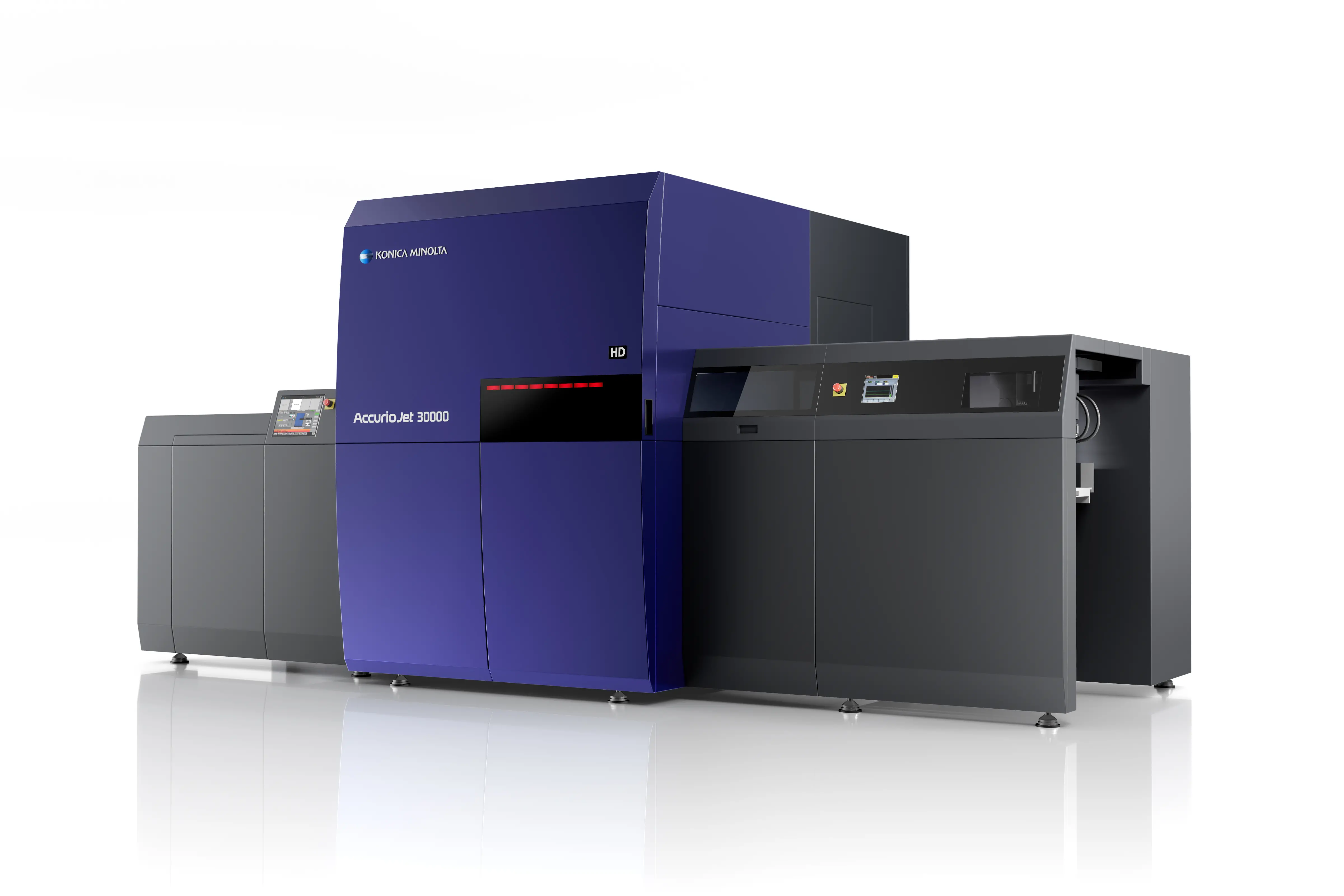
The AccurioJet 30000 represents the next generation of full-color UV inkjet printing, featuring a redesigned inking system that delivers sharper image quality while reducing maintenance demands. The press achieves output speeds of 3,000 sheets per hour single-sided and 1,500 double-sided, accommodating media sizes up to 585 x 750 mm. Its HD mode supports FM screening with precise dot placement, while the HS UV ink enables compatibility with a wide range of media.
Konica Minolta’s patented Dot Freeze technology further elevates image and text clarity, achieving results that rival—and even surpass—offset quality. To ensure customers get the most from their investment, Konica Minolta also provides White Glove support, delivering a premium service experience at every step.
In a landscape where printers are confronting shorter runs and faster turnarounds, products like the AccurioJet 30000 are lowering the barrier. “Digital has become more mainstream,” Mallozzi says. “Five to eight years ago, customers didn’t want to be guinea pigs. But today, commercial printers are more data-savvy. They have strong MIS systems that help them understand costs and inefficiencies. That makes the transition conversation easier.”
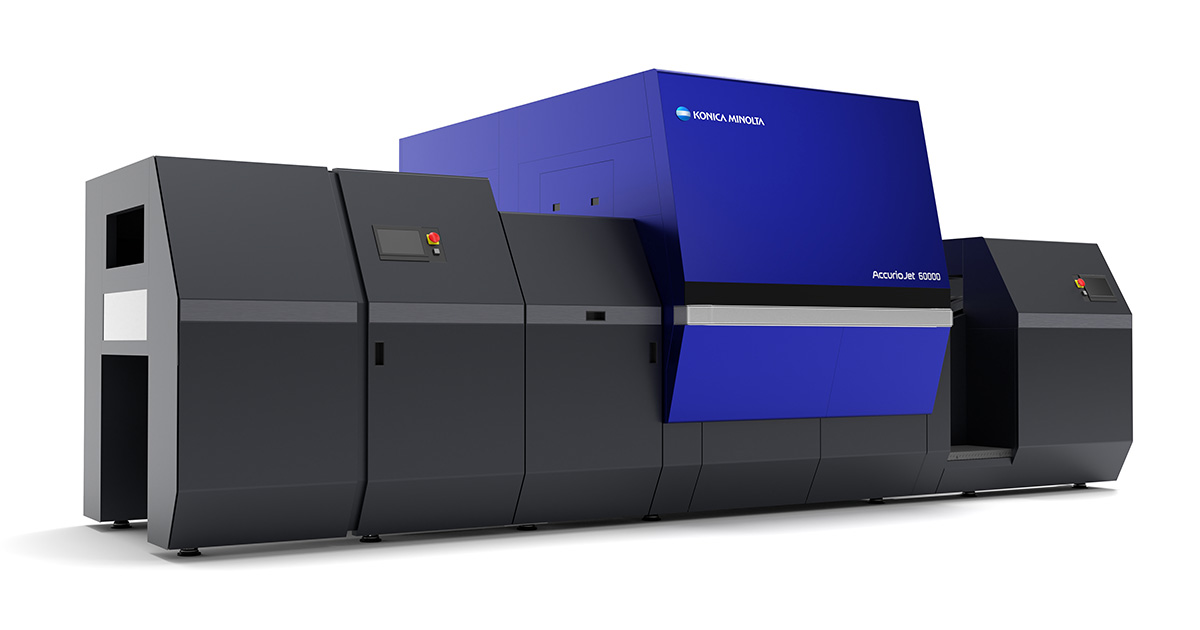
Also on the horizon, you may recall Konica Minolta, Inc. unveiled imagery of the AccurioJet 60000 at drupa 2024, further supporting the ongoing growth and expansion of its portfolio. The AccurioJet 60000 will offer output speeds of 6,000 sheets per hour single-sided and 3,000 double-sided.
A Playbook for Transition
For many commercial printers, moving from offset to digital requires more than just a new press. It requires a new way of thinking. That’s why Konica Minolta has developed a consultative approach that maps out the whole process and provides a total cost of ownership report.
“This helps identify pain points and inefficiencies in their current workflow,” Mallozzi says. “What jobs do they need to run profitably? What could move from offset to digital? The process is critical… Digital is generational. A new wave of printers has grown up with expectations for personalization, versioning and fast turnaround.”
With advances in inkjet inks and head technology, digital presses are meeting these expectations across applications once thought impractical. As Konica Minolta eyes the road ahead, Mallozzi and his team are focused on three primary areas:
- Labels – Helping converters and commercial printers move from analog to digital, especially in markets like microbreweries, cannabis, nutraceuticals, wine and candles.
- Embellishment – Enhancing existing work for higher margins, such as premium invitations with foiling.
- Production Inkjet (Konica Minolta’s inkjet platform) – Short-run B2 work in commercial print, book publishing, in-plants and even display graphics.
“Quality, once a concern, is no longer an issue,” Mallozzi says. “Our devices rival offset and customers are blown away. The next push is speed. As devices get faster, more work will shift from analog to digital. We [recently] announced a platform extension that will continue to expand our inkjet, embellishment and label offerings.”
For printers wanting to invest in inkjet, Mallozzi says the process is three-fold:
- Invest in technology and data—the steppingstone into AI.
- Spend time up front—discovery is key to finding efficiencies.
- Focus on details—from site surveys to installation, smooth implementation ensures full value.
“With all the emphasis on equipment, equipping customers with the tools and knowledge to grow their businesses is equally important,” Mallozzi says. “Our role is to help printers find the right fit, capture opportunities and thrive in a marketplace that increasingly values speed, personalization and quality.”