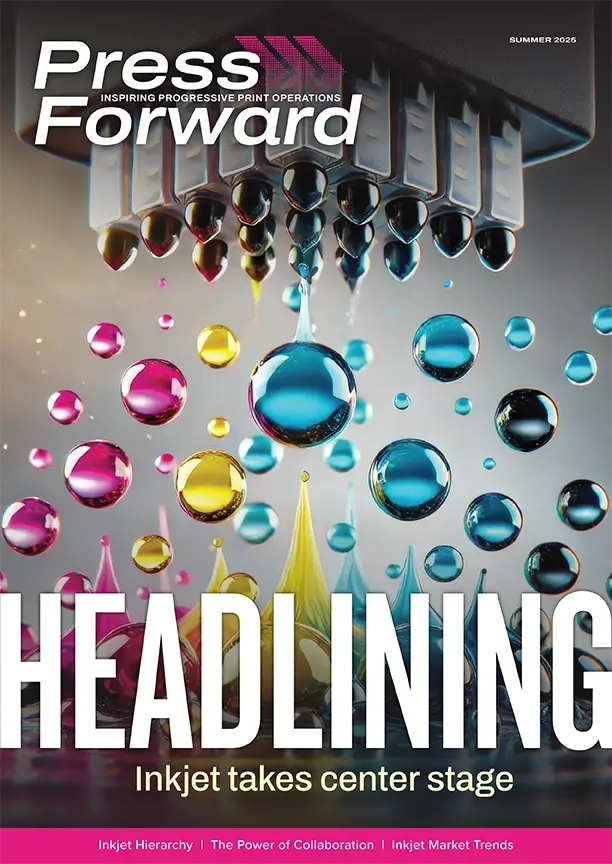
As the print industry navigates a fast-changing business landscape, production inkjet continues to take its place in the spotlight. Once viewed as a specialized solution for niche applications, industry thought leaders like Marco Boer believe today’s inkjet is reshaping how commercial printers approach efficiency, personalization and long-term growth.
Boer, VP of IT Strategies, believes the question isn’t whether inkjet deserves a starring role in a modern print strategy, but how soon printers can adopt it before they’re left behind in a print world that continues to consolidate.
“Inkjet isn’t just the future. For a lot of us, it’s already the present—and if you’re not planning for it now, you’re planning to fall behind.”
— Matt Reville, CEO, Consolidated Solutions
“As the industry shifts from a commodity-based model to a more luxury-focused one, everything that’s printed today must have immediate value,” Boer says. “That’s driving the need for shorter runs and hyper-targeted content. Inkjet is the most cost-effective way to deliver on those demands.”
Add rising paper and postage costs to the equation, and the economics of print are forcing an industry-wide rethinking of production strategies. But cost alone isn’t the only catalyst for inkjet’s rise. The ongoing labor shortage is accelerating the shift toward simpler, more automated production methods.
“It’s getting harder and harder to find skilled offset press operators,” Boer says. “When their lead operator retires, many printers retire their presses along with them. Inkjet presses require less specialized skill to operate, making them essential for staying productive with a smaller workforce.”
Boer says it is only a matter of time before inkjet isn’t a competitive advantage, but a requirement for survival. That means today’s printers are going to have to know when to make the leap. Boer advises printers to take a hard look at their long-term business outlook. “If you’re planning to exit the business in the next 12 months, inkjet isn’t the right investment. But if you’re in this for the long haul, you need to start learning—and fast.”
The learning curve continues to be the biggest hurdle. Success with inkjet doesn’t hinge on print quality or technical reliability. Today’s inkjet presses can rival offset and toner-based output in virtually every category. Instead, the challenge lies in shifting sales strategies, finding new customers, and migrating existing work onto the new technology.
“The moment a printer figures out how to fill their first inkjet press, they’re usually buying a second one not long after,” Boer says. “It’s about getting over that initial learning hump. Once you do, the business scales quickly.”
Boer is quick to dispel two of the most common myths surrounding inkjet adoption. The first is that inkjet quality isn’t good enough. “That’s simply outdated thinking. Look at the latest graphic arts inkjet systems. You’d be hard-pressed to tell the difference between offset, toner, or inkjet output.”
The second is that inkjet ink is prohibitively expensive. While it’s true that inkjet inks cost more per unit than traditional offset inks, Boer argues that focusing solely on ink price misses the bigger picture. “When you account for labor savings, reduced setup times, paper waste and the ability to produce personalized content that commands higher margins, ink cost becomes a much smaller factor. In today’s market, the real question is: What’s the value of the job, and how efficiently can you produce it?”
Boer sees the industry at a tipping point. Printers will either optimize for high-efficiency, commodity-driven work or lean fully into high-value, highly personalized offerings that create lasting customer relationships.
Either path leads to the same conclusion—inkjet will be at the core. “In the end, if you’re planning to be in the document printing business for more than two years, you really have no choice but to invest in inkjet,” Boer says. “And if that’s the case, you’re already late—but it’s not too late yet.”
From possibility to production
For Matt Reville, inkjet isn’t just a smart investment, it’s a strategic turning point. As one of the largest marketing production companies in the Midwest, Consolidated has long built its reputation on embracing innovation—and inkjet is no exception.
“We’re seeing demand for faster delivery times at scale without sacrificing quality,” says Reville, CEO of the Cleveland-based marketing production company. “Combine that with the need for high-volume personalization, especially in direct mail, and inkjet becomes a necessity. Traditional cut-sheet toner devices just can’t keep up.”
The tipping point came when Consolidated evaluated its mix of business and customer SLAs against its existing equipment lineup. The findings were clear: continuous-form inkjet offered a more cost-effective and efficient path forward. “We realized inkjet could replace multiple toner presses while delivering lower operational costs,” Reville says. “It wasn’t just about speed—it was about scalability, consistency, and smarter resource allocation.”
If there is one thing Reville wants printers not versed in inkjet to know it is that integrating the technology is not a plug-and-play strategy. From hardware differences to workflow adjustments, successful implementation requires deep planning and a clear understanding of your business model. “Not all inkjet systems function the same way. Quality, substrate compatibility, ink types, finishing capabilities—these vary significantly by manufacturer. The research doesn’t stop at the press; that’s just the beginning.”
Reville also believes that operational adjustments often are overlooked. Color management, paper profiling and imposition processes must all adapt to support inkjet. Beyond that, the shift often requires investment in new finishing and material-handling equipment to keep up with inkjet’s production speeds. “People don’t always anticipate how much change will be needed in prepress and postpress. It’s a systemwide shift, not just a press purchase.”
“If you’re planning to exit the business in the next 12 months, inkjet isn’t the right investment. But if you’re in this for the long haul, you need to start learning—and fast.”
— Marco Boer, VP, IT Strategies
That systemwide perspective is what allowed Consolidated Solutions to succeed with a major inkjet implementation. The company recently secured a high-volume direct mail program with extremely tight turnaround times. After assessing its needs, Reville’s team chose to invest in continuous-form inkjet. “We knew inkjet could print ten times faster than our toner devices. That speed made the project possible—and roll-fed finishing eliminated multiple postpress touchpoints.”
The result was not only a technical win, but a strategic one: faster throughput, fewer bottlenecks, and a more competitive offering in the high-demand direct mail space.
From improved quality to broader media compatibility, Reville believes inkjet is on track to absorb even more offset and digital volume. Because he expects press capabilities to evolve rapidly, Consolidated is maintaining strong partnerships with key manufacturers. “This keeps us on the cutting edge—and ensures we’re part of the conversation that shapes what’s next. Inkjet isn’t just the future. For a lot of us, it’s already the present—and if you’re not planning for it now, you’re planning to fall behind.”
As inkjet technology continues to mature, it’s no longer a question of if printers should adopt—it’s a matter of when. From strategic positioning to operational agility, inkjet is redefining what it means to compete and thrive in today’s commercial print landscape.
5 reasons inkjet matters today
1. Faster. Smarter. Efficient. – Powers short runs, high speed and personalization—without sacrificing quality.
2. Labor-friendly automation – Simplifies workflows and reduces staffing strain.
3. Real ROI – Higher ink cost. Lower total spend. Cuts waste. Reduces setup time and labor.
4. Offset-level quality – Rivals offset and toner visually and technically.
5. Business-wide impact – Enhances scale and agility.
Sources: Matt Reville, CEO, Consolidated Solutions; Marco Boer, VP, IT Strategies